
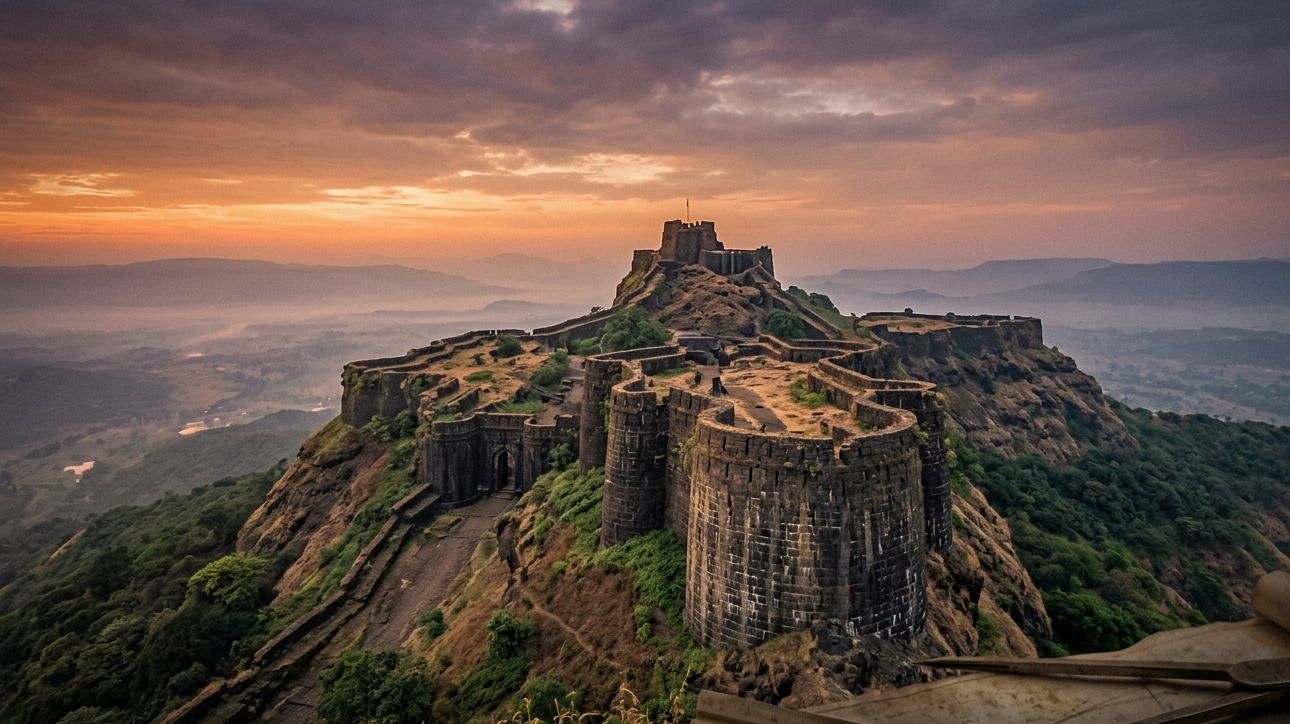
When we think of Chhatrapati Shivaji Maharaj, we often focus on his bravery and guerrilla warfare. However, as an engineer, when I look at Rajgad Fort-the first capital of the Maratha Empire-I see more than just a fortress. I see a high-availability, fault-tolerant system designed for 100% uptime under extreme stress.
Rajgad was the nerve center of the Maratha Empire for 26 years. To sustain a capital at 1,376 meters (4,514 ft) above sea level without modern electricity or pumps is an engineering feat that rivals the best modern logistics systems.
1.Strategic Architecture: The ‘Three-Leaf’ Defensive Logic
Rajgad is shaped like a three-petaled flower, consisting of three Machis (fortified plateaus) surrounding the central Balekilla (the highest citadel). From a systems design perspective, this is a multi-layered firewall:
- Padmavati Machi: The administrative and residential tier.
- Sanjivani Machi: The western defensive tier with triple-layered fortifications.
- Suvela Machi: The eastern strategic vantage point.
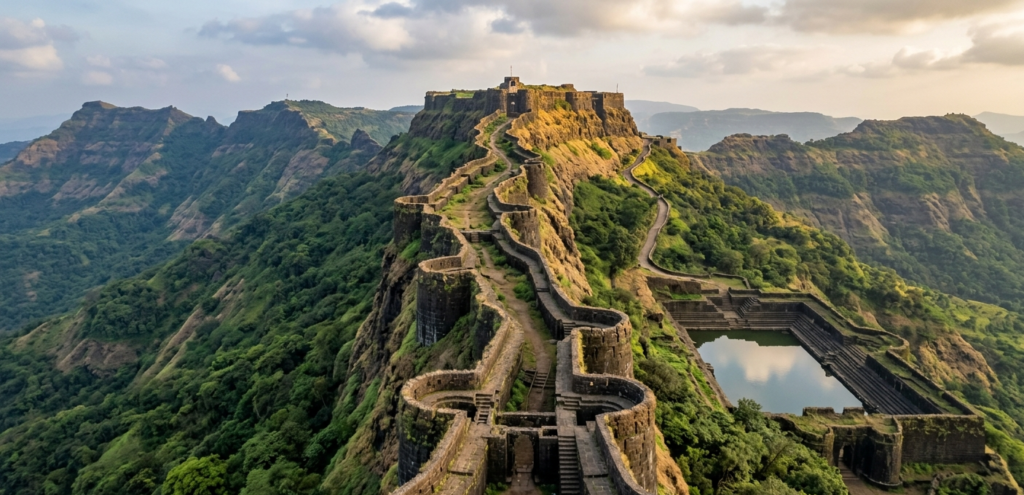
The Engineering Secret: The base diameter of Rajgad is roughly 40 km (25 miles). In 17th-century warfare, this was a “Denial of Service” (DoS) attack on enemy forces. It was physically impossible for an invading army to lay a complete siege around such a massive perimeter, ensuring that the fort’s supply lines remained open from at least one side.
2.Hydraulic Engineering: Infinite Water Supply Without Pumps
One of the biggest challenges for a hill fort is water. If the water runs out, the fort falls. At Rajgad, Shivaji Maharaj and his architects implemented a Gravity-Fed Decentralized Water Management System.
The Padmavati Lake & Rock-Cut Cisterns
Instead of relying on a single source, Rajgad features numerous rock-cut water cisterns and the massive Padmavati Lake.
- Rainwater Harvesting: The stone-cut tanks were designed to capture 100% of the heavy Sahyadri monsoons.
- Natural Filtration: The basalt rock acted as a natural filter, keeping the water cool and potable even during the scorching summers of Maharashtra.
- Redundancy: Each Machi had its own independent water storage. If one section of the fort was compromised, the others remained self-sufficient.
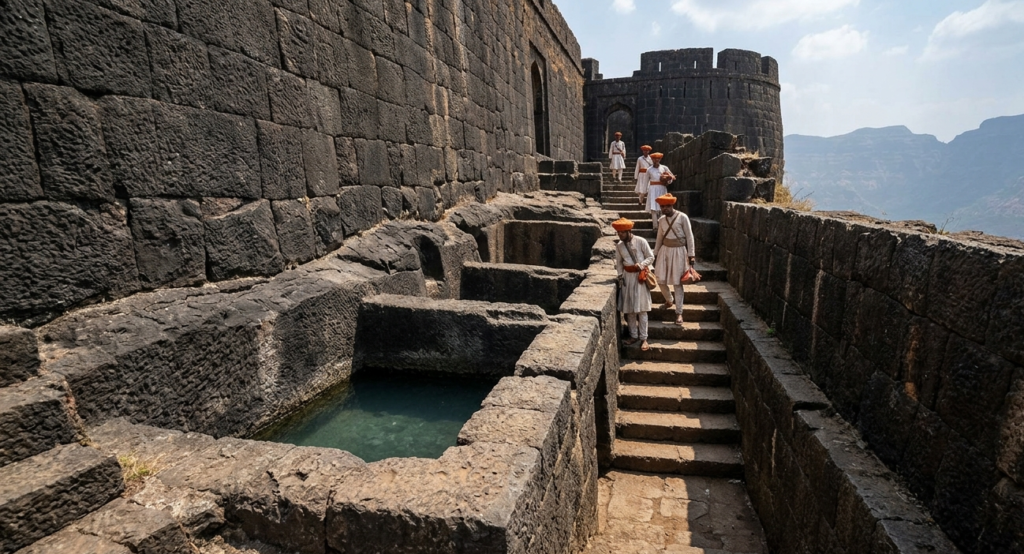
3. The ‘Maha Darwaja’ Logic: More Than Just a Door
As a Senior Dev, I look at the Maha Darwaja (Great Gate) as a Security Gateway.
- Blind Corners: The approach to the gate is curved. This meant that an invading army could not use a battering ram with full momentum—the curve physically limited the “bandwidth” of their attack.
- Bastion Synchronization: Two massive bastions, each 65-70 feet high, flank the gate. This allowed for 360-degree surveillance and cross-fire capability, ensuring no “unauthorized packet” (enemy soldier) could enter without being detected.
4.Resource Management: The Granary and Supply Chain
For Rajgad to function as a capital for 26 years, it needed an elite storage system. In engineering terms, this was their Long-term Persistent Storage.
The Balekilla Granaries
The Balekilla (the highest citadel) contains deep, rock-cut pits used as granaries (Amberkhane).
- Thermal Insulation: By carving these pits directly into the basalt rock, the engineers created a natural refrigerator. This kept the grain (mostly millets and rice) dry and cool, preventing mold and pests-crucial for a fort that faced 4-5 months of heavy monsoon.
- Redundancy: Grains were not stored in one place. They were distributed across the three Machis, ensuring that if one plateau was lost to fire or siege, the rest of the fort would not starve.
5.Logistics: The “Last-Mile” Challenge
How do you get tons of supplies up a 4,500-foot vertical climb ?
- Mule-Based Transport: The paths were engineered with specific gradients. They weren’t just random trails, they were carved to allow mules and horses to climb without the cargo shifting dangerously.
- Human-Centric Design: The steps were kept at a specific height to minimize fatigue for the Mavala (Maratha soldiers), who often climbed while carrying heavy loads.
6. Disaster Recovery: The ‘Chor Darwaza’ (Secret Backdoors)
In software, we have “Backdoor entries” for emergency maintenance. In Maratha architecture, every fort had multiple Chor Darwazas.
The Logic of Escape
These were not just “hidden doors”; they were strategically placed at the most vertical and “unclimbable” cliffs of the fort.
- Stealth Logic: An invading army would never monitor a 90-degree cliff. The Maratha engineers exploited this psychological blind spot.
- Failover Protocol: If the Maha Darwaja (Primary Gateway) was breached, the Royal family and the high command had a pre-defined “System Recovery” route to exit the fort and merge into the dense Sahyadri forests below.
7. The ‘Triple-Wall’ Security Architecture
The Sanjivani Machi features a unique engineering marvel: Triple-layered fortifications.
- Outer Wall: The first line of defense to stop infantry.
- Intermediate Space: A kill-zone for anyone who breached the first wall.
- Inner Wall: The final barrier, usually 10-15 feet higher than the outer one, giving the defenders a massive “High Ground” advantage.
This is exactly how modern Defense-in-Depth security works-if one layer is compromised, the next layer is ready to neutralize the threat.
8. Communication Systems: 17th-Century ‘Low-Latency’ Networking
For a capital to control a growing empire, it needed a way to transmit data across long distances instantly. Chhatrapati Shivaji Maharaj’s engineers treated the Sahyadri mountain range like a distributed network of signal towers.
Line-of-Sight (LoS) Communication
Rajgad was strategically positioned to have a direct line-of-sight with other major forts like Torna, Sinhagad, and Purandar.
- The Protocol: Using smoke during the day and fire/torches at night, the Marathas could transmit simple “status packets” (e.g., “Under Attack,” “Reinforcements Needed,” or “Victory”) across 50+ kilometers in a matter of minutes.
- Data Redundancy: If the weather was too cloudy for fire signals, a network of highly trained runners (the Jasoods) acted as the physical “data packets,” using secret mountain trails that were invisible to the enemy.
9. Environmental Sustainability: Building with the ‘Natural Stack’
One of the most impressive “Green Engineering” feats of Rajgad is that the construction was carbon-neutral and locally sourced.
- Self-Sustaining Stone Quarrying: Most of the stone used to build the massive walls was excavated from the mountain itself.
- The Genius Logic: The pits created by excavating stone were not left empty; they were converted into the rock-cut water cisterns. This is a perfect example of resource optimization-minimizing waste by turning a “construction hole” into a “utility asset.”
- The ‘Lime-Mortar’ API: The Maratha engineers used a specific blend of lime, sand, jaggery, and lead to bind the stones. This mixture is flexible enough to withstand the seismic activity of the Western Ghats and the extreme expansion/contraction caused by the monsoon-heat cycle. Unlike modern concrete which cracks in 50 years, this “legacy code” has survived for 350+ years.
Why Rajgad is the Ultimate ‘Legacy System’
As we look back at the Engineering Marvels of Rajgad, it becomes clear that this fort wasn’t just a pile of stones; it was a sophisticated, living machine. It was designed with:
- High Availability: (Constant water and food)
- Security in Layers: (Triple fortifications and blind-curved gates)
- Disaster Recovery: (Chor Darwazas)
- Optimized Logistics: (Strategic supply chains)
For a Senior Software Engineer, Rajgad serves as a timeless reminder that whether you are building a microservice or a mountain fortress, the principles of scalability, security, and sustainability never change.
The ‘King of Forts’ remains standing today as a testament to the vision of Shivaji Maharaj-a leader who was as much a master engineer as he was a warrior king.
Leave a Reply